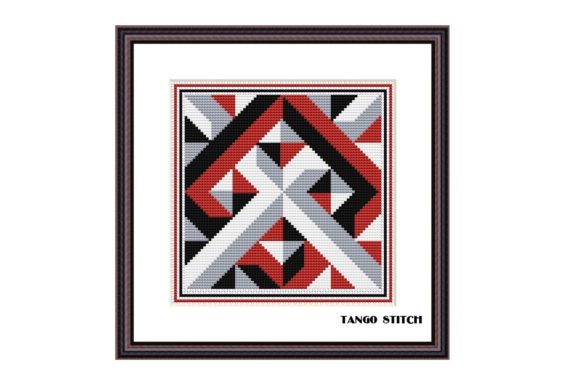
Geometric Ornament Cross Stitch Pattern
If you have ever browsed cross stitch patterns online, you have likely noticed that many designs fall into two camps: overly simple motifs that lack visual interest, or highly detailed patterns that require hundreds of color changes and fractional stitches. The Geometric Ornament Cross Stitch Pattern sits right in the middle. It offers a balanced, modern design that does not overwhelm beginners yet remains engaging enough for experienced stitchers.
This particular pattern uses only full crosses. That means no backstitch, no fractional stitches, and no complicated techniques. You work row by row, following a clear grid, and the image builds itself. For anyone who has ever abandoned a project halfway through because the pattern became too fiddly, this approach feels like a relief.
What makes this pattern different from other cross stitch designs
Many cross stitch patterns rely on partial stitches to create smooth curves or fine details. While that works well for photorealistic portraits or intricate florals, it also makes the stitching process slower and more error-prone. The Geometric Ornament Cross Stitch Pattern avoids that entirely. Every stitch is a full X, which makes the counting straightforward and the rhythm predictable.
The design itself draws from geometric ornament motifs, think repeating angular shapes, symmetrical lines, and balanced compositions. These kinds of patterns have a long history in textile arts across cultures, but they also feel contemporary when stitched in modern color palettes. You can stitch it in bold jewel tones for a dramatic look, or in muted earth tones for something softer.
Because the pattern relies on geometry rather than shading, the finished piece has a crisp, graphic quality. It works well as a standalone piece in a hoop or frame, but also fits into larger projects such as pillows, bags, or quilt blocks.
Who actually uses this pattern and why
The Geometric Ornament Cross Stitch Pattern tends to attract a specific kind of stitcher. Not the person looking for cute cartoon animals or nostalgic samplers, but someone who wants a modern, clean design that fits into contemporary home decor or a handmade product line.
Consider a freelancer who sells handmade goods at local craft markets. They need patterns that stitch up quickly, look professional, and appeal to customers who want something beyond rustic or traditional. This pattern fits that need. A single ornament can be stitched in a weekend, and the geometric style photographs well for social media or Etsy listings.
Similarly, a hobbyist who enjoys stitching while watching TV or listening to podcasts benefits from the repetitive, low-stress nature of full-cross stitching. There is no need to constantly check a reference image or worry about the angle of a partial stitch. You just follow the grid, and the design emerges.
Home decor that actually feels personal
Mass-produced decor is everywhere. But a geometric ornament stitched by hand, framed in a simple hoop, and hung on a wall carries a different energy. It shows time, care, and taste. Many stitchers use this pattern to create a set of matching ornaments in different color schemes for a gallery wall. Because the design is modular, you can repeat the same motif in multiple sizes or rotate the orientation for variety.
Another common approach is to stitch the ornament onto a pillow cover or a tote bag. The geometric lines hold up well on fabric, and because the stitches are full crosses, the back side remains relatively tidy. That matters if you are making a two-sided item or a gift where the inside might be visible.
Handmade gifts that avoid the usual cliches
Gifting a cross stitch piece can feel risky. Not everyone wants a flower bouquet or a kitten saying "home sweet home." But a geometric ornament has a broader appeal. It looks intentional and modern. A stitched ornament in a simple frame works well for a housewarming gift, a wedding gift, or even a holiday present when stitched in seasonal colors.
Because the pattern is simple enough to finish in a reasonable time, you can stitch multiple pieces for a group of friends without burning out. That matters for people who want to give handmade gifts but also have jobs, families, and other responsibilities.
Digital products for small shop owners
If you run a small business selling PDF patterns, the Geometric Ornament Cross Stitch Pattern is the kind of design that appeals to a wide audience. It is not so niche that only advanced stitchers attempt it, but it has enough visual sophistication that customers feel they are getting something stylish.
The PDF format means you can sell it as a digital download with no shipping costs. The pattern includes a main page with the embroidery image, a key, two pages with color and symbol patterns, a color symbols pattern spread across four pages for comfortable work, and a black symbols pattern also in four pages. That level of detail helps customers feel confident that they can complete the project without confusion.
Entrepreneurs who create pattern bundles often include geometric designs as filler pieces that complement larger projects. Because the pattern uses only full crosses, it works well for beginner-friendly bundles, which tend to sell better than advanced-only collections.
Classroom or workshop use
Teachers and workshop facilitators need patterns that are forgiving. When students are learning to read a cross stitch chart, manage thread tension, or count stitches accurately, a geometric ornament pattern reduces frustration. The repeating shapes allow students to spot mistakes quickly, and the lack of fractional stitches means they can focus on technique rather than complex maneuvers.
Many educators find that geometric patterns also work well for teaching color theory. By stitching the same ornament in different color combinations, students see how contrast and harmony affect the final piece. That kind of exercise is harder to do with a figurative design where color choices are dictated by the subject matter.
What to consider before buying or downloading this pattern
The Geometric Ornament Cross Stitch Pattern is not a one-hour project. Depending on the size and your stitching speed, expect to spend several evenings or a weekend on it. That is reasonable for most hobbyists, but if you are looking for a quick win, you might prefer a smaller motif.
Also consider your fabric count. The pattern works on 14-count or 16-count Aida cloth, but if you use a higher count such as 18 or 20, the finished piece will be smaller and the stitches will be finer. Beginners often prefer 14-count because the holes are larger and easier to see. Experienced stitchers sometimes choose 16-count for a tighter look. The pattern does not require any special fabric, which keeps the upfront cost low.
Thread colors are another consideration. The pattern comes with a color key, but you are free to substitute. Many stitchers use DMC or Anchor threads, and the chart maps well to standard floss colors. If you have a stash of leftover threads from previous projects, you might already have everything you need. That is a nice bonus if you are trying to stitch without buying new supplies.
For those who plan to sell finished items made from this pattern, check the license terms that come with the PDF. Some designers allow commercial use of finished products, while others restrict sales. If you run a handmade shop, you want to be clear on this point before you invest time and materials.
How the PDF structure supports your stitching experience
When you download the pattern, you receive a single PDF file containing multiple pages. The main page shows the full embroidery image, which helps you visualize the finished design before you start. The key page lists the thread colors and symbols, so you know exactly what to buy or pull from your stash.
Two pages present the pattern in color with symbols. Then you get a color symbols version spread across four pages for comfortable work, meaning you do not have to squint at a tiny chart or zoom in and out on a screen. The four-page split is especially useful if you print the pages and tape them together, or if you prefer to work from a binder.
Finally, there is a black symbols pattern also in four pages. That version removes the color background, which can make it easier to see the symbols clearly, especially if you are working under less-than-ideal lighting. Some stitchers prefer the black symbols version because it reduces visual noise and helps them focus on counting.
Having both color and black symbol versions gives you flexibility. You might start with the color version and switch to black symbols once you are familiar with the layout. That kind of thoughtful packaging shows that the pattern was designed with real stitching habits in mind, not just as a one-size-fits-all chart.
Why this pattern works for both beginners and experienced stitchers
A pattern that claims to suit everyone often works for no one. But in this case, the simplicity of full-cross stitching genuinely benefits both ends of the skill spectrum. Beginners gain confidence because they can complete a project that looks polished without struggling with fractional stitches or intricate backstitch lines. Experienced stitchers appreciate the efficiency and the chance to work on something that does not require constant chart checking.
For someone who stitches for relaxation, the repetitive motion of full crosses has a meditative quality. You fall into a rhythm, and before you know it, another row is done. For someone who stitches for production, such as making items to sell, the speed and consistency of full crosses mean you can produce multiple pieces with uniform quality.
Either way, the geometric ornament design ensures that the finished piece looks deliberate and stylish. It is not a pattern that tries to hide mistakes behind complexity. The geometry demands precision, but the full-cross method makes that precision achievable.
Practical tips for getting the most out of this pattern
If you plan to stitch this pattern, start by sorting your threads and marking your fabric center. With geometric designs, centering is important because the symmetry is part of the appeal. A misaligned ornament might still look okay, but it will not have the same crisp balance.
Work in good light and keep your chart accessible. The four-page color symbols version is easier on the eyes than squinting at a single dense page. If you prefer digital, zoom in on a tablet rather than a phone screen. Many stitchers find that using a magnetic board with a metal strip to hold their place works well for patterns like this.
Consider finishing options before you start. If you plan to frame the piece in an embroidery hoop, leave extra fabric around the edges. If you plan to sew it into a pillow or bag, account for seam allowances. A little planning upfront saves frustration later.
And do not be afraid to experiment with thread colors. The geometric ornament design is forgiving of color substitution. Try a monochrome version in shades of blue, or a high-contrast version with black and gold. The same pattern can look entirely different depending on your choices, which means you can stitch it multiple times without boredom.
Whether you are stitching for yourself, for gifts, for sale, or for teaching, the Geometric Ornament Cross Stitch Pattern offers a reliable, attractive, and accessible project. It respects your time, your skill level, and your desire to make something that does not look like everyone else's work. And in a world full of mass-produced decor and disposable goods, that kind of handmade intention matters.